Modeling and Control of an Autonomous Sailboat
Wind-aware waypoint navigation using a hierarchical controller and a genetic-algorithm comparison.
ROB 599 · University of Michigan · Team project
Sailboats can support long-duration autonomous missions using wind propulsion, but they cannot follow arbitrary headings. Their motion depends on sail trim, rudder deflection, wind, and ocean currents, and a waypoint may lie in a direction the boat cannot sail directly toward.
For this project, we built a sailboat model and explored how a hierarchical controller could connect waypoint navigation to the sail and rudder commands that move the vessel.
From Environmental Forces to Control Inputs
The model includes aerodynamic forces on the sail, hydrodynamic effects, and ocean-current contributions to the boat’s motion. Sail forces use NACA airfoil data, providing a basis for studying how sail orientation affects propulsion.
The control architecture has three parts:
- Waypoint-level planning: A simplified Dubins-style model generates desired motion using a blended LQR and proportional heading controller.
- Sail and rudder control: An angle-based controller uses apparent wind to trim the sail and heading error to command the rudder, subject to actuator limits.
- Wind-aware replanning: Waypoints within a no-sail region extending 45 degrees to either side of the incoming wind are skipped in favor of the next available waypoint.
This replanning rule makes the demonstration tractable, but it does not perform tacking to reach upwind targets.
Waypoint Navigation in Simulation
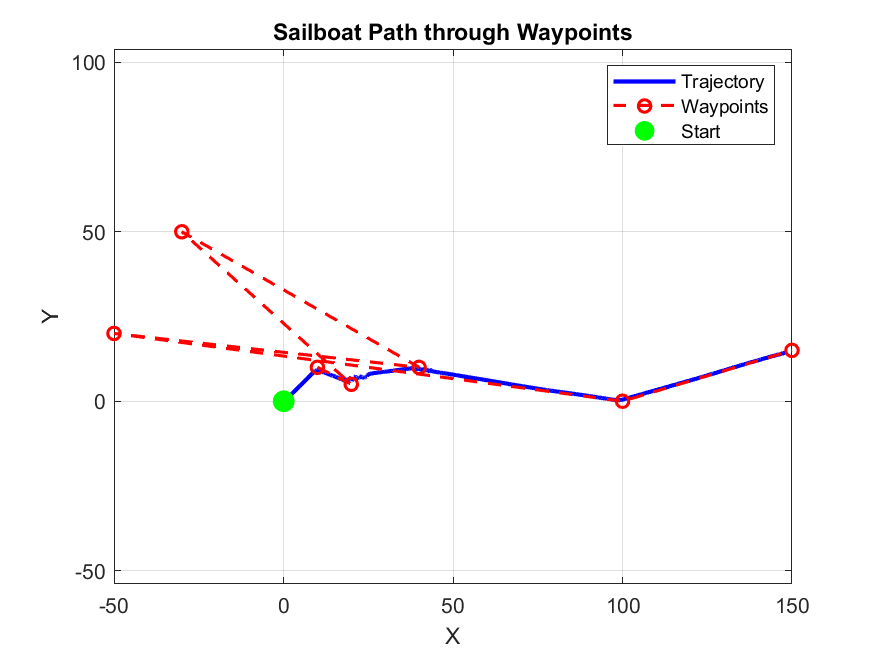
The test uses seven requested waypoints and treats a waypoint as reached when the boat comes within 2 m. The controller reaches five of the seven waypoints; the other two are bypassed by the wind-aware replanner.
This is an important distinction: the simulation demonstrates navigation among feasible targets, rather than completion of every requested waypoint. Reaching the skipped targets would require additional planning behavior, such as tacking.
Comparing a Learned Search Approach
We also explored a genetic algorithm that searches over candidate control signals, using waypoint navigation performance to evaluate each candidate.
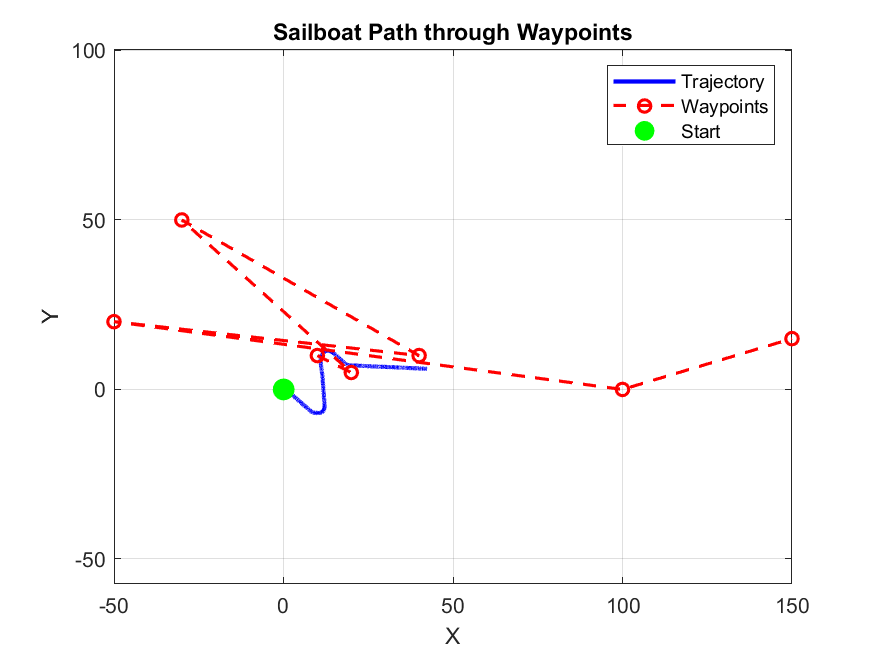
In the reported run, the GA did not evolve a controller that completed the route. The comparison highlights a practical limitation of direct search over complex nonlinear dynamics: the training budget and fitness design can be as important as the choice of algorithm.
Scope and Next Steps
These results come from simulation. The waypoint demonstration does not establish robust performance across arbitrary changing wind conditions, and simplified sail and rudder dynamics limit the model’s fidelity. Useful extensions include tacking-aware planning, more realistic environmental variation, and feedback from onboard sensors.
Team and Code
Developed with Ben Bruick and Matt Prince.